Around St. Blasii Cathedral and the Burgplatz (Castle Square)
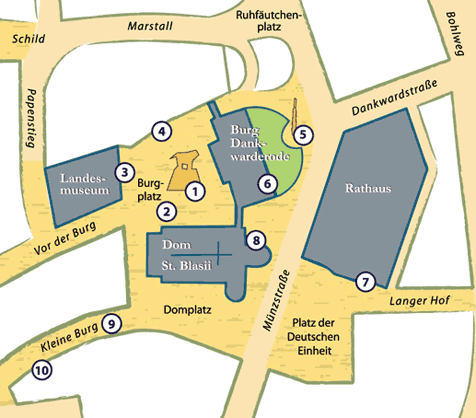
Dating back as far as the 9th century you could already find the castle of the Brunones on the Burgplatz. In the 12th century Henry the Lion built the original Dankwarderode Castle, the collegiate church St. Blasii, now the cathedral, and the Lion Statue. The neo-classical Vieweghaus as well as the many beautiful half-timbered buildings make the Burgplatz a very important historical architectural ensemble. The square still shows the original medieval ground plan.
-
Emblem of Henry the Lion and the first freestanding monument of the Middle Ages
-
This was the centre of power of the Guelphs in the 12th century.
-
This old publishing building now hosts the Braunschweig State Museum.
-
This house is an example of the second building period in Braunschweig that was influenced by bourgeois art. Right next the house of family von Veltheim.
-
This nine metre high bronze column depicts the history of Christendom by combining many single sculptures.
-
This used to be the residence of Henry the Lion.
-
This sign of municipal self-government was built in Neo-gothic style in 1894.
-
This Roman three-nave basilica was built in 1173 and is the burial place of Henry the Lion and Emperor Otto IV.
-
This is one of the few preserved old streets in Braunschweig.
-
These canon’s residences were built in the 15th century by the monastery St. Blasii